• Skip to main content
  • Skip to primary sidebar
  • Skip to footer
blog.draftsperson.net

blog.draftsperson.net

the art of technical drawing

blog.draftsperson.net

Pen Sizes and Line Types (Metric)

July 29, 2019

Last updated July 29, 2026

By Steve
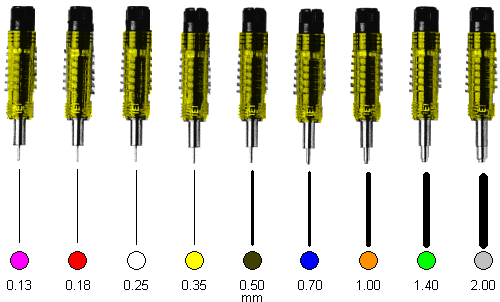
Nine technical drafting pens with their ISO colour codes and nib widths in mm: 0.13 magenta, 0.18 red, 0.25 white, 0.35 yellow, 0.50 brown, 0.70 blue, 1.00 orange, 1.40 green and 2.00 grey
Colors on the old drafting pens
The ISO defines a set of standard metric line widths for drafting.
Like the ISO A and B series sheet sizes, the pen sizes increase by a factor of 2. This allows additions and corrections to be made on the enlargements or reductions of drawings.
Each width is assigned a color code. The color code corresponds to that for the matching lettering stencil.
Line widths and color codes are standardized across all manufacturers.
 
Letter Type of Line Line Thickness (mm) Application
    A0 A1 A2
A3
A4
 
A Continuous – thick

Type A line sample: continuous thick
 
0.7 0.5 0.35
  • Visible outlines
B Continuous – thin

Type B line sample: continuous thin
 
0.35 0.25 0.18
  • Fictitious outlines
  • Imaginary intersection of surfaces
  • Dimension lines, projection lines, intersection lines and leaders
  • Hatching
  • Outlines of revolved sections
  • Adjacent parts and tooling
  • Fold and tangent bend lines
  • Short centerlines
C Continuous – thin, freehand or ruled with zig-zag

Type C line sample: continuous thin, drawn freehand with an irregular wavering path and a zig-zag break

 
0.35 0.25 0.18
  • Indication of repeated detail
  • Break lines (other than on an axis)
D Dashed – medium

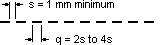
Type D line sample: dashed medium, evenly spaced dashes

 
0.50 0.35 0.25
  • Hidden outlines
E Chain – thin

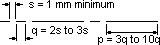
Type E line sample: chain thin, long dashes separated by short ticks

 
0.35 0.25 0.18
  • Centerlines
  • Pitch lines
  • Alternative position of moving part
  • Path lines for indicating movement
  • Features in front of a cutting plane
  • Developed views
  • Material to be removed
F Chain – thick at ends and at change of direction, thin elsewhere

Type F line sample: chain, thick at each end and at changes of direction, thin along the middle
 
0.7
0.35
0.5
0.25
0.35
0.18
  • Cutting planes
G Chain – thick

Type G line sample: chain thick
 
0.7 0.5 0.35
  • Indication of surfaces to meet special requirements

Filed Under: Drafting History, Drafting Standards

Primary Sidebar

Subscribe to our Youtube Channel

Post CAD drafting jobs on Freelancer.com. and get some free money to do this.

Categories

  • American Steel Industry (4)
  • AutoCAD Articles & Reference (30)
  • AutoCAD Bugs & Problems (19)
  • AutoCAD Tips (29)
  • AutoCAD Tutorials (54)
  • AutoLISP Routines (328)
  • AutoLISP Tutorials (15)
  • CAD Standards (7)
  • Civil 3D (7)
  • Civil Drafting (4)
  • Dimensions (2)
  • Drafting Funnies (71)
  • Drafting History (9)
  • Drafting Standards (84)
  • Electrical Drafting (2)
  • General IT reference (7)
  • Geometry (15)
  • GIS (2)
  • Hatch Patterns (12)
  • Office Life Hacks (3)
  • PT (1)
  • Revit Tutorials (54)
  • Steel Detailing (14)
  • Structural Drafting (26)
  • Technical Dictionary (61)
  • Useful Website Links (19)

Footer

Free downloads

  • Free AutoLISP routines
  • Free hatch patterns
  • SHX fonts & text styles
  • Numbering LISP collection
  • ISO 3098B font

Reference charts

  • AWS weld symbols chart
  • Steel detailing chart
  • Hole & slot sizes
  • Bolt edge distance
  • ANSI & ARCH paper sizes
  • How to fold an A1 drawing

Useful links

  • CAD blocks (DWG)
  • Revit families
  • structuraldrafter.com
  • cad-corner.com
  • About
  • Privacy policy

Provided for free with no warranty · Log in