
Last updated July 28, 2026
This information applies to the American Steel Industry.
The hole sizes below are the nominal hole dimensions tabulated in ANSI/AISC 360-22, Specification for Structural Steel Buildings — Section J3.2 covers the size and use of holes, and Table J3.3 is the table itself. Confirm against the edition your project is designed to before detailing from any chart on a website, including this one.
Holes and Slots
Standard Holes
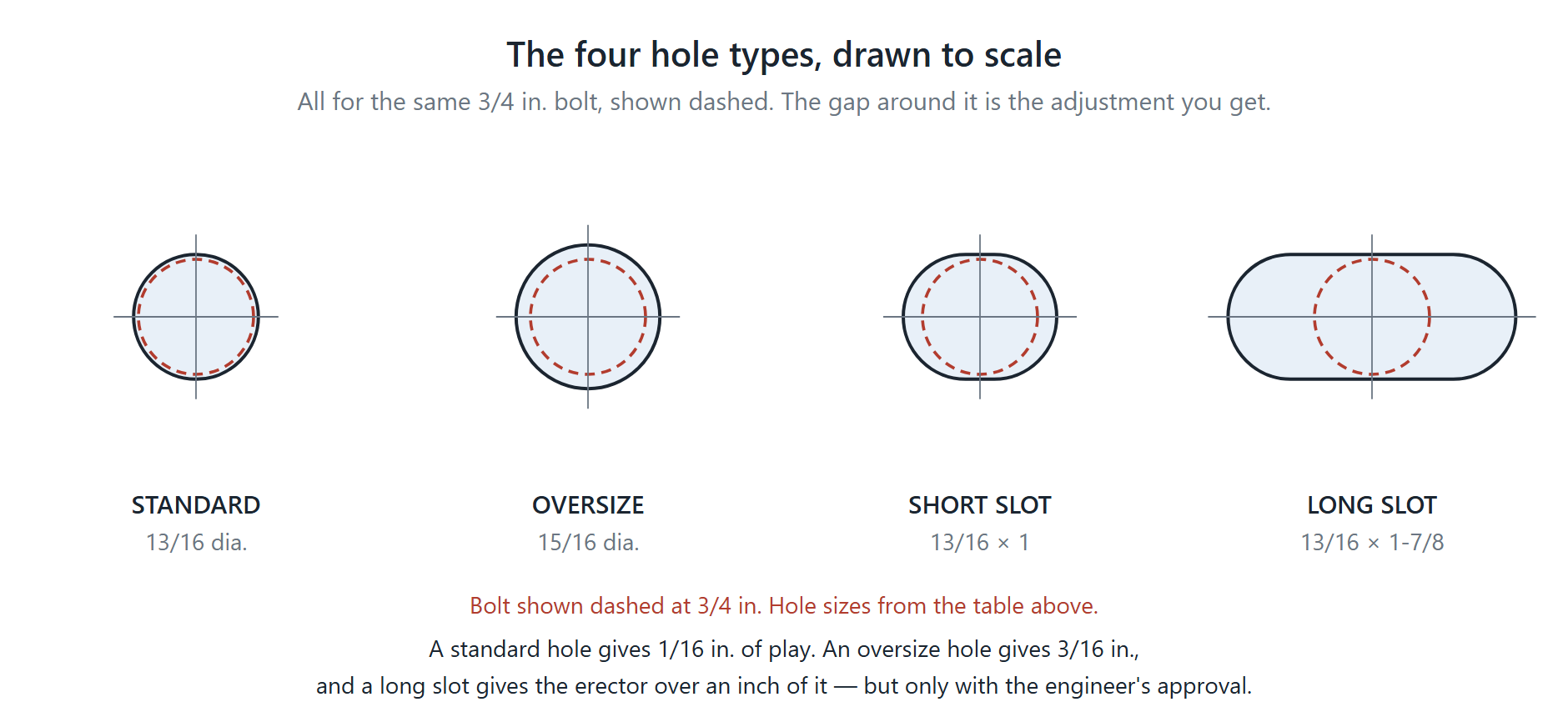
Standard hole sizes for bolts are made 1/16-in. larger in diameter than the nominal size of the fastener body. This provides a certain amount of play in the holes, which compensates for small misalignment’s in hole location or assembly, and aids in the shop and field entry of fasteners. In the absence of approval by the engineer for use of other hole types, standard holes shall be used in high strength bolted connections.
Although most holes for high-strength bolts are made 1/16-in. larger in diameter than the bolt body, certain conditions encountered in field erection require greater adjustment than this clearance can provide and approval from the engineer is required.
The maximum sizes of holes for bolts are given in the table below, except that larger holes, required for tolerance on location of anchor bolts in concrete foundations, are permitted in column base details.
Standard holes shall be provided in member-to-member connections, unless oversized, short-slotted or long-slotted holes in bolted connections are approved by the designer. Finger shims up to 1/4-in. may be introduced into slip-critical connections designed on the basis of standard holes without reducing the allowable shear stress of the fastener.
Oversize and Slotted Holes
When approved by the engineer, oversize, short slotted holes or long slotted holes may be used subject to the following joint detail requirements:
(1) Oversize holes may be used in any or all plies of connections in which the allowable slip resistance of the connection is greater than the applied load. Oversized holes shall not be used in bearing-type connections. Hardened washers shall be installed over oversized holes in an outer ply.
(2) Short slotted holes may be used in any or all plies of connections designed on the basis of allowable stress on the fasteners provided the load is applied approximately normal (between 80 and 100 degrees) to the axis of the slot. Short slotted holes may be used without regard for the direction of applied load in any or all plies of connections in which the allowable slip resistance is greater than the applied force. Washers shall be installed over short-slotted holes in an outer ply; when high strength bolts are used, such washers shall be hardened.
(3) Long slotted holes may be used in one of the connected parts at any individual faying surface in connections designed on the basis of allowable stress on the fasteners provided the load is applied approximately normal (between 80 and 100 degrees) to the axis of the slot. Long slotted holes may be used in one of the connected parts at any individual faying surface without regard for the direction of applied load on connections in which the allowable slip resistance is greater than the applied force. Where long-slotted holes are used in an outer ply, plate washers or a continuous bar with standard holes, having a size sufficient to completely cover the slot after installation, shall be provided. In high-strength bolted connections, such plate washers or continuous bars shall not be less than 5/16-in. thick and shall be of structural grade material, but not be hardened. If hardened washers are required for use of high-strength bolts, the hardened washers shall be placed over the outer surface of the plate washer or bar.
(4) Fully inserted finger shims between the faying surfaces of load transmitting elements of connections are not to be considered a long slot element of a connection.
Nominal Hole Dimensions
| Bolt Diameter | Hole Dimensions – Standard Diameter | Hole Dimensions – Oversize Diameter | Hole Dimensions – Short Slot (Width x Length) | Hole Dimensions – Long Slot (Width x Length) |
| 1/2 | 9/16 | 5/8 | 9/16 x 11/16 | 9/16 x 1 1/16 |
| 5/8 | 11/16 | 13/16 | 11/16 x 7/8 | 11/16 x 1 9/16 |
| 3/4 | 13/16 | 15/16 | 13/16 x 1 | 13/16 x 1 7/8 |
| 7/8 | 15/16 | 1 1/16 | 15/16 x 1 1/8 | 15/16 x 2 3/16 |
| 1 | 1 1/16 | 1 1/4 | 1 1/16 x 1 5/16 | 1 1/16 x 2 1/2 |
| >= 1 1/8 | d + 1/16 | d + 5/16 | (d + 1/16) x (d + 3/8) | (d + 1/16) x (2.5 x d) |
Anchor Bolt Holes
Hole sizes for steel-to-steel structural connections are not the same as hole sizes for steel-to-concrete anchorage applications. In the case of steel-to-steel connections, the parts are made in a shop under good quality control, so standard holes (bolt diameter plus 1/16″), oversized holes (bolt diameter plus 3/16″), and short and long-slotted holes can be used quite successfully. However, the field placement of anchorage devices has long been subject to more permissive tolerances (and often, inaccuracies that exceed those tolerances anyway and may require consideration by the structural Engineer of Record).
AISC published Steel Design Guide Series 1, Column Base Plates back in the early 1990s. At that time, it was recognized that the quality of foundation work was getting worse and worse. To allow the erector (and designer) greater latitude when possible, the permissible hole sizes in base plates were increased. These same larger hole sizes were included in the 2nd ed. LRFD Manual. The values there are maximums, not a required size. Smaller holes can be used if desired. Plate washers are generally required with these holes because ASTM F436 washers can collapse into the larger-sized holes, even under erection loads.
The larger hole sizes are primarily intended for the majority of base plates that transfer only axial compression from the column into the foundation. The anchor rods don’t usually do much after erection in that case.
To allow for misplaced bolts, holes in base plates are oversized. The AISC Manual of Steel Construction recommends the following oversized hole diameters for each bolt diameter:
Anchor Bolt Hole Dimensions
| Bolt Diameter | Hole Size |
|---|---|
| 3/4 | 1 5/16 |
| 7/8 | 1 9/16 |
| 1 | 1 13/16 |
| 1 1/4 | 2 1/16 |
| 1 1/2 | 2 5/16 |
| 1 3/4 | 2 3/4 |
| 2 | 3 1/4 |
| 2 1/2 | 3 3/4 |
AISC, Steel Design Guide Series 1, Column Base Plates, suggests that using oversize holes meeting these criteria may still not accommodate field variations in anchor bolt placement and suggests adding 1/4 in. to the hole diameter listed. The guide recommends using a heavy plate washer over the holes. The AISC Structural Steel Educational Council cites the following example: “If bolts are misplaced up to 1/2 inch, the oversized base plate holes normally allow the base plate and column to be placed near or on the column line. If the bolts are misplaced by more than 1/2 inch, then corrective work is required.”
Based on AISC oversize holes, the AISC Structural Steel Educational Council recommendations, and concrete contractor anchor-bolt placement techniques, ASCC (American Society of Concrete Contractors) concrete contractors recommend the following tolerance for each bolt location:
- 3/4-in. and 7/8-in. diameter bolts: ±1/4 in.
- 1-in., 1-1/4-in., and 1-1/2-in. diameter bolts: ±3/8 in.
- 1-3/4-in., 2-in., and 2-1/2-in. diameter bolts: ±1/2 in.
Hole size and edge distance are two halves of the same decision: the hole fixes where the bolt can go, and the edge distance fixes how close to the edge it may sit. If you are laying out a connection, read them together — Minimum bolt edge distances has the companion chart, in both the imperial and the metric series.
More steel detailing references
- Minimum bolt edge distances
- Calculating structural bolt lengths
- AWS weld symbols chart
- Printable steel detailing chart
References
- ANSI/AISC 360-22, Specification for Structural Steel Buildings — Section J3.2 and Table J3.3 cover hole sizes; J3.4 covers minimum edge distance
- ANSI webstore — ANSI/AISC 360-22
- AISC Steel Design Guide 1, Base Plate and Anchor Rod Design — the source of the oversized base plate hole sizes above
- Minimum bolt edge distances — the companion chart
- Calculating structural bolt lengths